
· Updated
How AI Automation Strengthens Your Local SEO
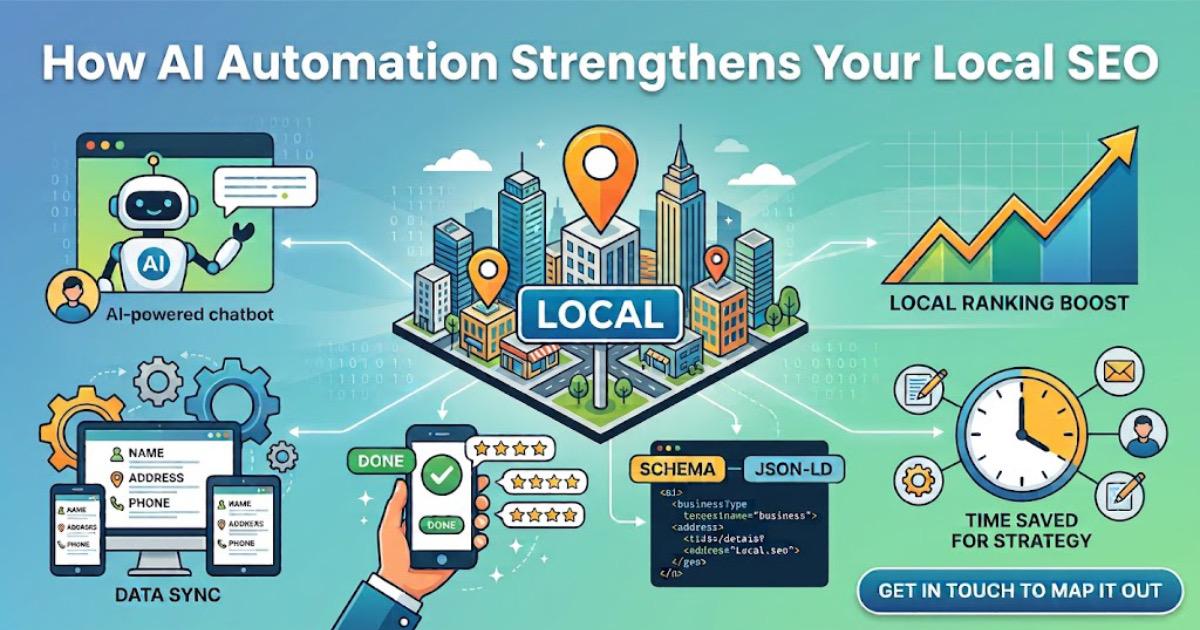
AI automation strengthens local SEO by improving the signals that decide whether a business appears in local search and Google's map results: more and more recent reviews, consistent business details everywhere you're listed, and fast responses to every enquiry. It doesn't write your content or build links, but it takes the repetitive work off your plate so those signals stay strong without constant effort.
When most small businesses in Chesterfield, Sheffield and across Derbyshire think about local SEO, they think about keywords, Google Business Profile listings, and maybe a few backlinks. Fewer think about automation — but some of the biggest local ranking signals aren't about your website content at all. They're about how quickly you respond, how consistent your business information is everywhere it appears, and how many recent reviews you have. Those are all things automation can genuinely help with.
Does responding faster help local visibility?
Search engines and directory platforms increasingly factor in engagement signals: how quickly a business responds to enquiries, how often calls go answered, how many conversations actually lead somewhere. A lead who gets an instant reply is more likely to convert, leave a review, and come back — all of which feed back into your visibility over time.
An AI Sales Assistant or AI Chatbot that responds the moment someone fills in a form, and an AI Voice Solution that answers calls outside office hours, close that gap. None of this replaces your team — it just means nobody's enquiry sits unanswered overnight. Our guide to stopping lead loss after 5pm covers how to set this up.
How does automation keep your business details consistent?
Name, address, and phone number (NAP) consistency across your website, Google Business Profile, and every directory you're listed on is one of the more boring but genuinely important local SEO fundamentals. Search engines cross-reference this information, and mismatches — an old phone number on one directory, a slightly different address format on another — quietly undermine trust signals.
This is exactly the kind of repetitive, easy-to-neglect task that workflow automation and system integration are suited to: keeping your core business information in sync across the places it needs to live, instead of relying on someone remembering to update five different platforms every time something changes.
Can you automate getting more Google reviews?
Review count and recency are among the most well-established local ranking factors, and they're also one of the easiest things to automate. A simple sequence — a text or email asking for a review a day or two after a job's finished — consistently outperforms hoping customers remember to leave one unprompted.
Business automation built around your actual job or booking process can trigger that ask automatically, every time, without it depending on someone remembering to send it.
What does structured data do for local search?
Beyond what a visitor reads on the page, schema markup (structured data) gives search engines an explicit, machine-readable description of your business — what you do, where you serve, how to contact you. This site uses it site-wide, including LocalBusiness and per-service markup, precisely because it helps search engines understand the business accurately rather than inferring it from page text alone. It's a small technical detail with an outsized effect on how reliably you show up for the right searches.
What local SEO work still needs a person?
None of this replaces the parts of local SEO that genuinely need a person — writing locally relevant content, responding to reviews with real answers, posting updates to your Google Business Profile. What automation changes is how much time is left for that work once the repetitive admin — data entry, follow-ups, answering the same questions — is handled on its own.
If you're spending most of your week on the busywork, there's less of it left for the visible, ranking-relevant work that actually needs your judgement.
If you want to talk through where automation could make the biggest difference for your business, get in touch — we're happy to map it out with you.
Frequently asked questions
- Does AI automation directly improve Google rankings?
- Not on its own. It improves the signals that local rankings depend on, such as review count and recency, consistent business details and how quickly you respond to customers, and it frees up time for the local SEO work that needs a person.
- What is the quickest local SEO win from automation?
- Automatic review requests. Sending every customer a review link a day or two after the job consistently brings in more, and more recent, Google reviews than asking by hand.
- What is NAP consistency?
- NAP stands for name, address and phone number. Search engines compare these details across your website, Google Business Profile and directories, and mismatches weaken trust in your listing.
- Can automation post to my Google Business Profile for me?
- It can help prepare and schedule updates, but posts, photos and replies to reviews work best when a person reviews them, because they need local knowledge and your own voice.
Services mentioned in this article
Streamlines core workflows to reduce costs and improve accuracy.
Workflow AutomationConnects systems and automates repetitive tasks.
System IntegrationUnifies business tools into a cohesive ecosystem.
AI Sales AssistantAutomates lead qualification, appointment scheduling, and prospect nurturing.
AI Voice SolutionsNatural-language voice assistants for customer inquiries and booking.
AI ChatbotsInstant support handling common questions with escalation capability.
Keep reading
- How Much Does AI Automation Cost for a UK Small Business?
What AI automation costs a small business in Chesterfield, Sheffield or anywhere in the UK: build and running costs, what drives the price, and whether it pays off.
- How to Stop Losing Leads That Come In After 5pm
Evening and weekend enquiries go to whoever replies first. How small businesses in Chesterfield and Sheffield can answer, qualify and book them automatically.